The modern office is designed to bring people together. Open layouts, shared workspaces, collaborative meeting areas, and flexible seating can support communication, connection, and teamwork.
But when sound is not considered as carefully as furniture, lighting, or technology, people can struggle to focus.
Nearby conversations, ringing phones, video calls, impromptu meetings, and hallway traffic can all compete for attention. Individually, these sounds may seem minor. Together, they can make focused work, private conversations, and recovery between meetings much harder.
The goal is not a silent workplace. Silence is not practical, and it is not what most employees want. The goal is acoustic choice: giving people access to the right environment for the work they need to do.
Office Noise Is a Business Issue
A workplace should help people work well, not ask them to overcome their environment just to concentrate.
Research has found that intelligible background speech can impair short-term memory, reasoning, and wellbeing, even at relatively low sound levels. In other words, it is not only how loud an office is that matters. It is whether employees can understand the conversations around them while trying to think, write, analyze, or solve problems. Liebl et al., 2012
Background speech may also add mental strain during concentration-heavy work. In a controlled study, speech was associated with greater perceived workload and physiological stress responses than silence or non-speech noise during demanding tasks. Radun et al., 2021
This makes acoustics a business performance issue. When people must repeatedly redirect their attention, rebuild their train of thought, or leave their desk to find privacy, the friction can add up across the day.
The Problem Is Not Sound. It Is Uncontrolled Sound.
A productive office does not need to be quiet all the time. Teams need conversation, collaboration, and the energy that comes from working around other people.
The issue is uncontrolled sound: noise reaching people at the wrong time, in the wrong place, while they are trying to do work that requires attention or privacy.
Different tasks need different acoustic conditions.
- A quick team check-in may benefit from an open, energetic setting.
- A confidential conversation needs speech privacy.
- A video call needs a space that protects both the caller and nearby colleagues.
- Writing, analysis, design, and planning often require fewer interruptions and less intelligible speech nearby.
Research in office-like environments has shown that as background speech becomes more intelligible, performance on several demanding cognitive tasks can decline. The authors concluded that acoustic design should reduce speech intelligibility through measures such as sound absorption and appropriate masking. Haka et al., 2009
A healthy workplace supports these different modes of work instead of forcing every activity into one shared sound environment.
Three Ways Noise Undermines Focused Work
Not all sound affects employees in the same way. It is helpful to separate workplace noise into three related challenges: distractions, interference, and interruptions.
Distractions happen when an unexpected sound captures attention. A passing conversation, phone alert, or burst of activity can pull someone away from the work in front of them.
Interference happens when background information competes with the task at hand. Speech is especially disruptive because people are often reading, writing, thinking through ideas, or participating in conversations of their own.
Interruptions happen when someone has to stop a task altogether. Even after the interruption ends, they still need to redirect attention and rebuild their place in the work. Research shows that longer and more cognitively demanding interruptions can delay a person’s return to a suspended task. Monk, Trafton, and Boehm-Davis, 2008
These moments may seem small, but they matter most in roles that require concentration, creativity, accuracy, or confidential communication.
Privacy Is Part of Productivity
Workplace privacy is often treated as a comfort feature. It is also a performance feature.
Employees need places where they can make a call, participate in a video meeting, think through a complex task, or have a sensitive conversation without feeling exposed to the entire office. When those spaces are unavailable, people take calls from desks, hallways, and shared areas, creating more disruption for everyone.
Conference rooms alone are rarely the answer. They are often designed for groups, frequently booked, and inefficient for a single person who needs 20 minutes of quiet focus or a private call.
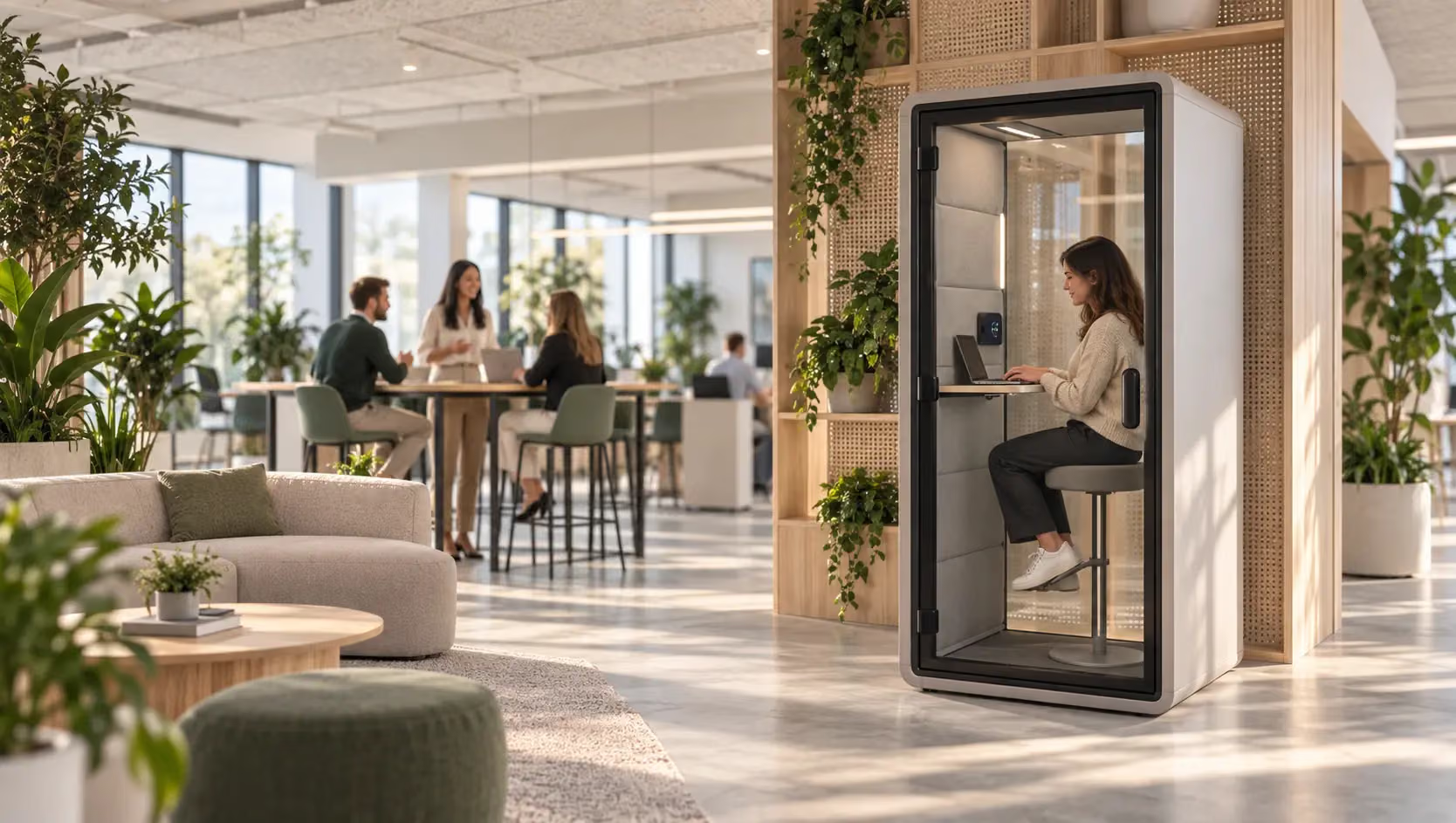
This is where Thinkspace helps organizations create a more adaptable workplace. With private, semi-private, and wellness spaces, organizations can give employees more choice in where they focus, take calls, meet in small groups, or take a moment to reset, without relying exclusively on open workstations or overbooked conference rooms.
The result is not an office that is silent. It is an office that is easier to use.
Quiet Matters, but Silence Is Not the Whole Goal
The best workplace sound strategy is not about eliminating every sound. It is about reducing unnecessary disruption and creating clear boundaries between different types of activity.
In a space that is too quiet, every keyboard tap, cough, or phone call can become more noticeable. In a space that is too loud, employees may struggle to hear themselves think.
Acoustic balance sits between those extremes. It may include sound absorption, enclosed rooms, spatial zoning, soft materials, thoughtful layouts, and designated spaces for calls and focused work.
International guidance for open offices recognizes that acoustic planning should be matched to the activities a space is intended to support, including collaboration and individual focused work. ISO 22955:2021
Designing for Acoustic Choice
Improving office acoustics starts with understanding how people actually work.
Where do employees take calls? Where do they go when they need to concentrate? Which spaces create the most noise? Where does sound travel farther than it should?
From there, organizations can create a more flexible workplace through:
- Private spaces for calls, video meetings, and heads-down work
- Semi-private spaces for small-group collaboration
- Quiet areas for focus-heavy tasks
- Sound-absorbing materials that reduce echo and reverberation
- Layout strategies that separate social, collaborative, and focused work areas
- Wellness spaces that give employees a place to reset during a demanding day
Field research reinforces the value of this approach. In a study of 113 employees, performance on a concentration-demanding task was lower in shared and open-plan offices than in cellular offices. Within activity-based workplaces, employees also performed better in quiet zones and enclosed work rooms than in unrestricted active zones. Jahncke et al., 2020
Thinkspace supports this approach by helping organizations add purpose-built spaces where they are needed most. Instead of asking every employee to work effectively in the same acoustic environment, the workplace can offer options that fit the moment.
The Future Office Needs Choice
Employees come to the office for connection, collaboration, culture, and access to resources they may not have at home. They also need the ability to focus.
A workplace that ignores sound can create unnecessary friction. A workplace that plans for sound can create clarity, privacy, and flexibility.
Better acoustics are not simply about reducing noise. They are about supporting the full rhythm of work: conversation and concentration, energy and calm, teamwork and privacy.
When employees can choose the right environment for the task in front of them, the office becomes more comfortable, more functional, and more human.
Create a Workplace That Gives People Choice
Ready to reduce distractions and give your team better options for focused work, private calls, collaboration, and reset moments?
Thinkspace can help you identify the right mix of private, semi-private, and wellness spaces for your workplace.